Programs

General Hamper Program

  • The General Hamper and FoodShare Distribution Programs are designed to provide perishable and non-perishable food and other necessities of life to the hungry people of Kamloops, Chase, Barriere, Savona, Logan Lake, Monte Lake, Pinatan Lake and Pritchard as well as the Kamloops Indian Band, Neskonlith Indian Band and Skeetcheestn Indian Band. Food is packaged into hampers by volunteers and staff. Clients access non-perishable hampers monthly and hampers of perishable foods up to twice weekly.

  • Staff and volunteers distribute food hampers which include single, couple, family, large family, emergency, diabetic, transient, and pre and post-natal to our clients.  The need for our services is growing each year. In 2007 Kamloops Food Bank (KFB) served 4496 clients. In 2008, 5512 clients. In 2009, 6771 clients. In 2010, 6931 clients. In 2011, 6817 clilents. Our clients often access KFB more than once a month which is clearly indicated by the fact that an average of 2400 clients are served monthly, but have 4368 client visits per month. There has been a noticeable increase in the number of first time users with an average of 123 new clients each month in 2011.
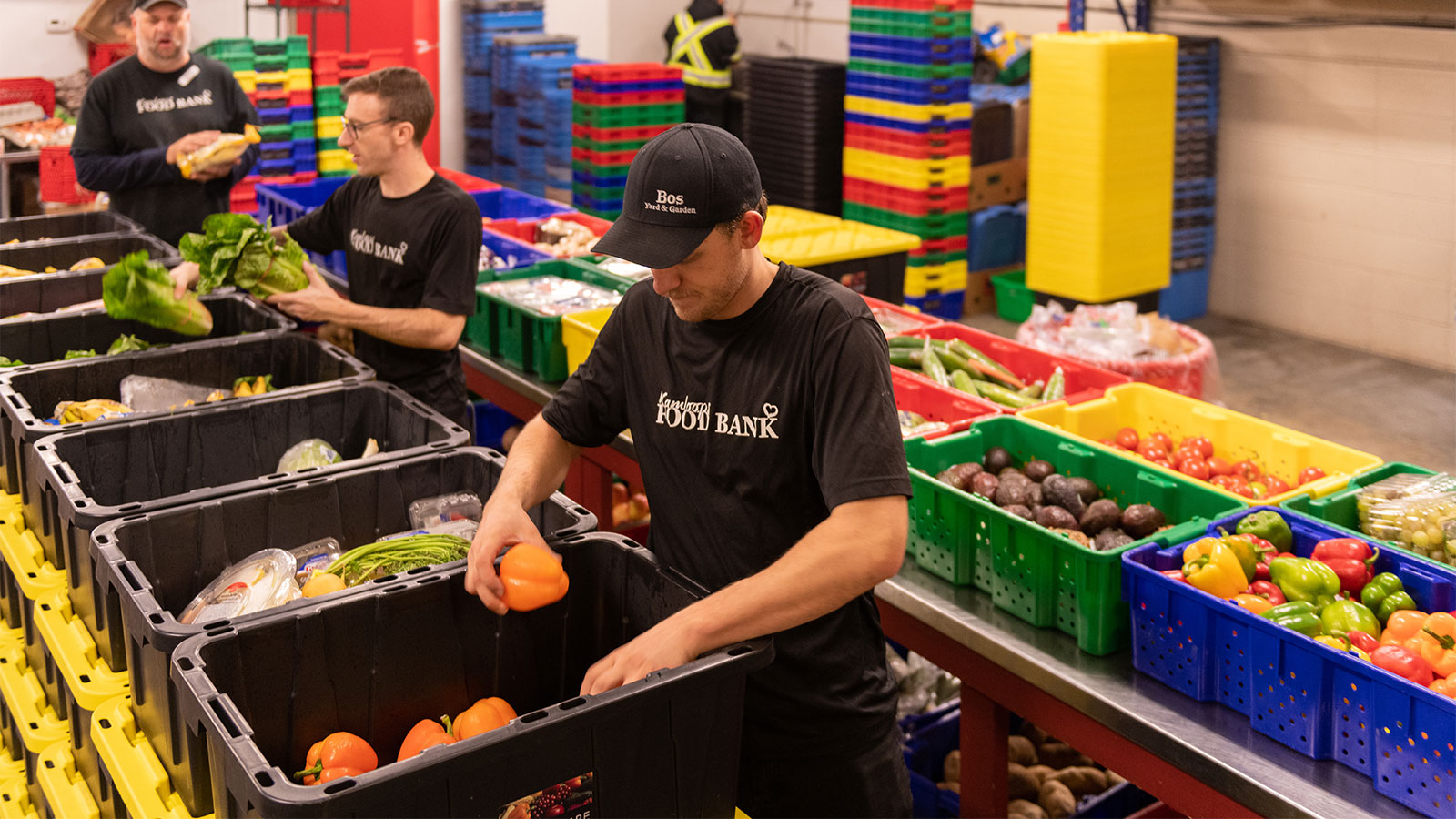
  • The donated food is received at the loading dock and then sorted into appropriate boxes by food type for storage. The foods are checked for expiry date, damage, spoilage, and defects before being stored. Bulk food is broken down into bags and containers according to the hamper size and stored in the supply shelves until needed to build hampers for distribution.
  • On average 10 to 15 volunteers are required daily to support the General Food Hamper and FoodShare Distribution Programs. The Kamloops Food Bank received almost 12,000 hours of volunteer help in 2011.

FoodShare Program

  • Major grocery stores, bakeries and other food outlets donate their close dated, perishable food to the FoodShare program. The food is picked up seven days a week. The food is returned to the Food Bank, where it is sorted, cleaned and placed in cold storage for distribution as soon as possible.

  • The FoodShare program allows our clients to access produce, breads, dairy and baked goods twice a week.

  • Prior to the initiation of FoodShare the perishable, close dated foods ended up in the landfill. By January 2012 we had diverted almost 4 million pounds of nutricious food from landfill to client hampers and agencies that feed the hungry.

  • FoodShare supports our 6817 clients yearly as well as 38 local schools and agencies in Kamloops that provide meal programs.

Specialty Hampers

  • Diabetic Hampers
    Upon proof from a doctor our clients may receive diabetic hampers. The diabetic hampers  contain sugar free non-perishable food. Avaliability of diabetic hampers is especially important for our aboriginal clients.

  • High Protein Hampers
    Upon proof from a doctor that a client requires a high protein diet they may receive our high protein hamper. These hampers are normally provided to pregnant women and nursing moms. Individuals with serious illness may also be eligible.
  • Transient Hampers
    Hampers are avaliable with canned goods that have re moveable lids. Foods which require little preparation are included in these hampers.

Other Programs

  • Community Gardens
    Five plots from the Community Gardens program are planted in the spring with vegetables and root crops. This is supported by the Daybreak Rotary Club. The food is picked and brought to the Food Bank for distribution to its clients. In 2011, we harvested 2289 pounds of beets, carrots, beans, onions and potates. A special recognition to Jim Mackenzie for his dedicated efforts.
  • Gleaning Program
    Each summer two students are hired through a grant from Service Canada to tend to the community and demonstration gardens and to pick donated fruit and vegetables from private gardens in the community for distribution at the Food Bank. in 2011, our gleaners collected 4300 pounds of produce. The gleaners have a very busy summer schedule, to ensure your garden is picked, please call in June to get on their list.
  • Basics for Babies
    This is a gala breakfast fundraising event which solicits funds to support pre and post natal mothers as well as to purchase baby food and hygiene products for children up to age two. Additionally, a large amount of baby food and supplies are donated at this event.
  • Rotary Food Drive
    The Rotary Food Drive takes place in the spring and fall of each year. The five Rotary clubs and Rotaract support the event by providing  volunteers to collect food from all areas of the city. An amazing 250,000 pounds of non-perishable food has been colected by Rotary since the first food drive in October 2008. The 2011 Spring Food Drive is set for Saturday, April 21st. Volunteers are always need at Interior Vault to help sort the donations collected by Rotary.
  • CP Holiday Train
    This Christmas event is a free family oriented gala which is well attended by the public. It takes place mid December and assists to increase awareness of Food Bank usage across the Country and encourage financial and food donations from local individuals and businesses
  • Baby Bank – formally the Thrift Store
    The Thrift Store has recently transformed into a Baby Bank. The Baby Bank provides clients with children 2 and under access to hygiene items, clothing, and basic baby necessities such as bottles and soothers on a monthly basis.

Employment Programs and Volunteers

The Society consistently applies for and is granted employees at no charge from the following programs:

  • Direct Suspention – These are students suspended from school who volunteer at the Food Bank during the period of their suspension

  • International Students – These TRU students must complete a community service component in order to receive credit for the class ‘Service 1000′.

  • Katimavik – A Federal government employment training program for youth ages 17-21. The participants are volunteers and work in one community for three months before relocating to another community. The Society receives one or two volunteers at no cost from each rotation to work in the warehouse.
  • Restorative Justice – This program offers young offenders Community Service opportunities instead of a criminal record.
  • Shuswap Training and Employment Program (STEP) – A First  Nations person is hired for a six month period, funded by Service Canada.

  • TRU Students – Social Work or Nursing students may complete one of their practicum assignments at the Food Bank. A final project is typically a requirement of completion and has included flu clinics, diabetes screening and the provision of pre and post natal information and classes.
  • Volunteer Programs – This is an important program which recruits volunteers for the operation of the Food Bank. Approximately 1100 hours of volunteer time monthly is required to operate the Food Bank as it is a labour intensive operation.
  • Work Experience - Secondary students are able to complete a portion of their experience in the workplace at the Food Bank. We have had an especially strong relationship with NorKam.